
Piscataway Previous Residents by Era
A backward address trail moves across record systems. The Middlesex land index is the practical start for a recorded transfer. Parcel data supplies identifiers and physical-location context. Older household evidence comes from the specifically verified regional directories, census schedules, library files, and archives. The table separates what a source can show from what it cannot. No row by itself proves every person who lived at a property.
| Source | Years it covers | Where held | What it can show |
|---|---|---|---|
| Middlesex deed-index notice | Deeds 1929-present | County Clerk BrowserView and land records | Recorded parties, instruments, and legal-description trail |
| County digitization notice | Deeds back to 1923, document type must be checked | NewVision Official Records | Older online deed access reported by the County |
| State Archives county deeds | Generally through 1900 on microfilm | New Jersey State Archives | Earlier county land-record and index route |
| New Brunswick-area directories | 1901-02, 1903-04, 1906, and 1908 | State Library Segment IV Reel 1 | Publication-period Piscataway or regional presence |
| Library and census research | Period-specific | Kennedy Library, HeritageQuest, FamilySearch | Household, map, family, and historical context |
Start with the county index when the suspected transfer falls in its stated range. If the lead reaches further back, move to the State Archives and library route instead of assuming that an empty online search means the property had no earlier history. Directory and census results then help distinguish a recorded owner from the people associated with the address.
Piscataway Previous Residents Start With Parcels
For past residents, a street number is only the first identifier. The Middlesex County parcel layer can supply a property location, municipality, `UNIQUEID`, old block and lot fields, property class, land description, and map geometry. Its `OwnersName` display field and owner-mailing fields are useful leads, but an owner’s mailing address is not the same as the parcel’s physical location. An estate, trust, business, or other entity can also appear as the owner.
Use the County GIS or NJGIN Property Explorer to locate the parcel, then keep the block, lot, old-block, old-lot, and legal-description information beside the address. The county layer is updated monthly as assessor MOD-IV information changes. A municipality-level owner-name search was not located, so the Piscataway Tax Assessor is the local contact for assessment-card questions and current municipal records.
Note: A parcel layer maps tax information and geometry. It cannot by itself establish that a named owner occupied the Piscataway address.
Piscataway Deed Index Cutoffs
The Middlesex County land-record coverage notice states deeds from 1929 to the present, mortgages from 1950 to the present, and other documents from 1958 to the present. A 2022 County announcement separately says public deeds were digitized from the 1950s back to 1923 through NewVision Official Records. These facts should be read together, not collapsed into one universal date. The exact live coverage can vary by document type, so confirm the selected record before concluding that an older transfer is absent.
The County coverage notice is the first official screen to consult before opening the browser search.
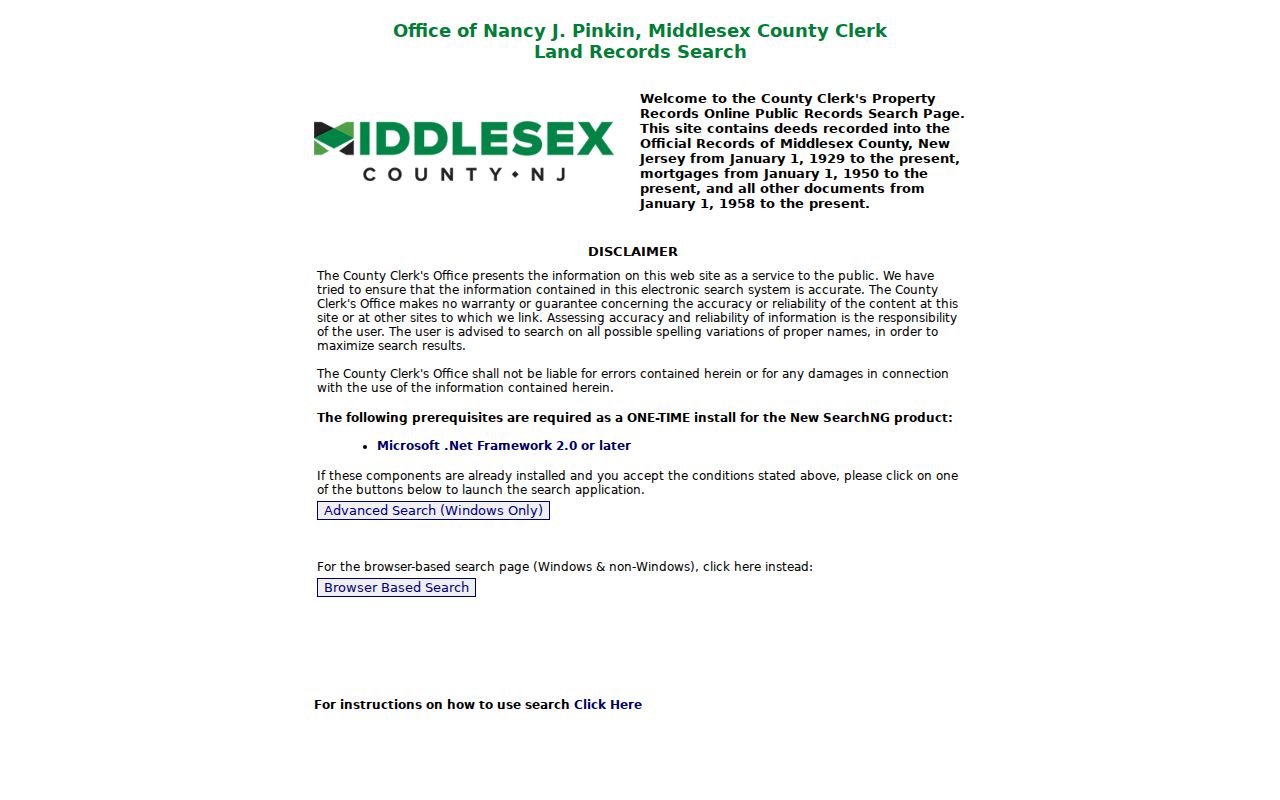
The visible range explains why an address search may need both the online index and a historical records request.
Trace Previous Piscataway Owners in Deeds
The Middlesex BrowserView search supports name, instrument number, book and page, town, block and lot, date, document-type, and legal-description modes. For an address history, choose Piscataway where the town control is available and search a party name in the portal’s documented `Last-Name First-Name` form without commas. The portal itself advises spelling variations. Search the buyer and seller directions separately, and classify each instrument before treating it as a transfer.
- Locate the parcel and record its legal description, block, lot, and any old block or lot identifier.
- Find the most recent relevant recorded instrument by party, parcel information, town, date range, or book and page.
- Read the parties and document type. A deed may mark a transfer; a mortgage, release, easement, or lien may not.
- Use the seller or earlier grantee name to locate the preceding acquisition, while preserving the same legal description and parcel context.
- Repeat back through the stated online coverage, then ask the County Clerk or State Archives about the older deed and microfilm route.
- Grantor and grantee
- The grantor conveys an interest in an instrument. The grantee receives that interest. Their roles should be read from the specific record.
- Chain of title
- The sequence of recorded transfers and related instruments attached to a property, assembled backward from a known instrument.
- Legal description
- The parcel description used in land records. It is often steadier than a street number when tracing an older Piscataway address.
Piscataway Previous Residents and Old Addresses
There is no verified official Piscataway chronology for street renumbering or road-name changes. That negative finding is useful. It means a search should not assume that a modern number can be carried unchanged into an earlier directory, map, or deed. When a number fails, try the road-name variant, the old block and lot, the legal description, a nearby landmark, and the surrounding community wording.
The process is simple: address to parcel, parcel to legal description, legal description to deed index, then date the household evidence. Keep each step in a research log. A same-name parcel elsewhere in Middlesex County, or a similar road name in a neighboring place, should not be merged into the chain without matching parcel context.
Address tip. A legal description and an old block or lot can bridge an uncertain street number when historic road wording and modern mapping do not line up.
Note: No official Piscataway street-renumbering chronology was located, so road variants and parcel identifiers should be retained with every historical search.
Piscataway House History at Kennedy
The Piscataway Public Library Local History Collection at Kennedy Library is the human layer in a previous-resident search. Its files can include family histories, maps, photographs, architectural drawings, correspondence, diaries, manuscripts, newspapers, oral histories, and material about historic houses, schools, roads, churches, and local institutions. Those sources may explain who was connected to a place after the deed chain has established the parcel trail.
Material remains in the library. Cataloged items can be brought elsewhere in the building with a librarian, while uncataloged files and thorough research need an appointment through ask@piscatawaylibrary.org. Kennedy Library is at 500 Hoes Lane and lists 732-463-1633. A brief, first-come librarian session during open hours can help identify the relevant house, family, map, or subject file before a deeper appointment.
Past Piscataway Households in Directories
Recorded ownership is only one part of an address story. A directory can place a name in the regional community during publication, while a census gives a household at its enumeration date. The only explicitly verified Piscataway directory checkpoints are the 1901-02, 1903-04, 1906, and 1908 New Brunswick-area J. Heidingsfeld runs on Segment IV Reel 1. A separate Piscataway reverse-directory shelf has not been located, so do not claim that an address-order listing exists until a librarian verifies it.
- Match the suspected household period to one of the confirmed directory years and record its regional place label.
- Compare the name, road, rural-route, and community wording with the 1900, 1910, 1920, or 1930 census route.
- Check county deeds and library maps when the directory and census use different address forms.
- Use cemetery, church, probate, and newspaper material to test a move, death, or family connection.
The confirmed collections themselves are described on the Piscataway Directory Book. Here, their role is narrower: date a household clue within an address-by-address trail.
Piscataway Previous Residents in Archives
The New Jersey State Archives genealogical collections are the key fallback when an address trail reaches before the online index. The Archives describes county deeds generally available on microfilm through 1900, with some indexes extending beyond that point. It also holds older estate, court, naturalization, vital, and newspaper material. Estate originals are described from 1670 to 1900, and surrogate records from about 1785 to 1900.
The State Archives genealogy search page provides the historical research route.
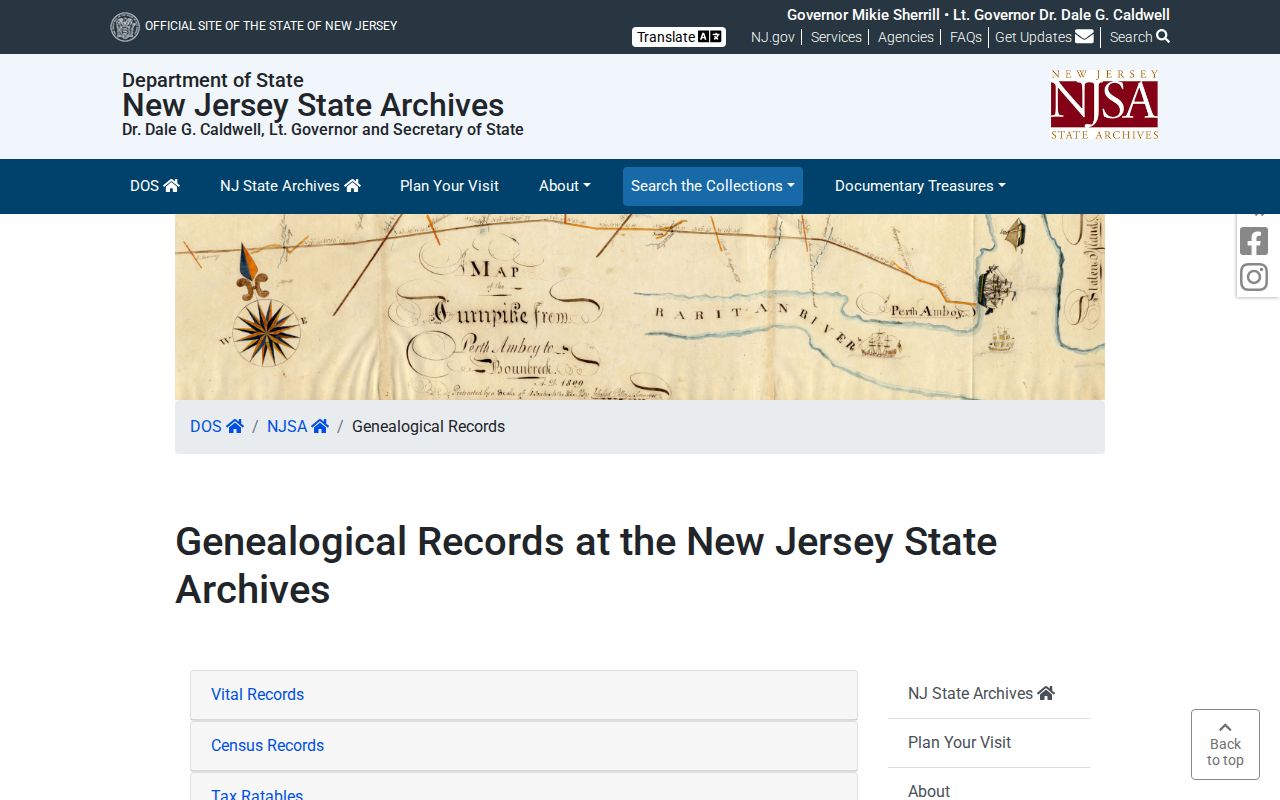
For an earlier household, pair land evidence with a family, church, cemetery, or county record rather than asking one source to answer every question.
The New Jersey State Archives is also a public research facility with free research access and a current copy-fee schedule.
The online access page is a reminder that archival research can continue at the facility when a digitized result is incomplete.
Note: A deed, census schedule, and archive file each have distinct dates and purposes, so record the source type beside every name.
Piscataway Previous Residents Map Gap
Sanborn fire-insurance maps are often useful for placing a building in time, but no Piscataway-specific Library of Congress Sanborn edition was located in the research. Do not describe a Sanborn year, sheet, or building detail for a Piscataway address without first locating the actual edition. The Library of Congress local-history guidance, the State Library, and Kennedy Library are appropriate places to ask about available map holdings.
Historic maps, parcel geometry, old block and lot fields, deed legal descriptions, and the River Road landmarks below are the documented alternatives. They provide orientation, not a substitute for an unlocated map edition.
Piscataway Previous Residents on River Road
River Road offers a concrete example of why address history needs more than a number. Middlesex historic material identifies Cato Hoagland House at 1050 River Road, Cornelius Low House at 1225 River Road, and Metlar-Bodine House at 1281 River Road. The County describes River Road as part of the old Great Road Up the Raritan. Those durable landmarks can help reconcile a road, crossroads description, later parcel geometry, and deed wording.
The Cato Hoagland property also carries a local people story: the County reports that Hoagland bought the house in 1862 and lived there until 1899, within a crossroads community that included schoolteachers, innkeepers, carpenters, butchers, and a bacteriologist. It illustrates a succession of connections to a place, not a template for inferring unrecorded residents at another address.
Lawful use. Piscataway previous-resident research is for house history, family research, estate questions, and personal curiosity. Do not use an address trail to track, threaten, or harass a living person.