
Trace a Piscataway Street Directory
A street-by-street search works best as an address record chain. USPS standardizes the location. The county parcel layer then supplies the identifiers used for land records. A deed can identify parties to a transaction, but it does not establish that either party currently lives there. Voter and historical-directory material are separate, dated clues. Their value comes from comparison, not from treating one entry as a complete household list.
The chain also keeps Piscataway sources in the right jurisdiction. The Township Tax Assessor handles municipal assessment questions, Middlesex County maintains parcel and recorded-land layers, and state resources supply broader property and election context. Start with the address itself instead of a guessed name. This helps distinguish a parcel owner, a mailing contact, a past deed party, and a registered voter.
- Use the official USPS ZIP Lookup by-address mode to standardize the street, city, state, unit, directional, and suffix information.
- Locate the Piscataway parcel through the Middlesex Parcels Public layer or NJGIN Property Explorer. Note municipality, UNIQUEID, block, lot, old block and lot, legal description, and LASTUPDATE.
- Use the parcel clues in Middlesex BrowserView. Select Piscataway as the town and search relevant party names, date range, document type, or block and lot.
- Ask Middlesex County about the authorized voter-list route under N.J.S.A. 19:31-39. Treat a registration address as civic evidence, not proof of present occupancy.
- For an older address, compare the parcel description with the 1901-1908 New Brunswick-area directory runs, census material, maps, and library history sources.
Note: Preserve the spelling and suffix returned for the address, because small format differences can prevent a later parcel or deed search from lining up.
Normalize Piscataway Street Addresses
The USPS lookup has three verified modes: By Address, By City and State, and Cities by ZIP. Its job is delivery formatting and routing. Enter the full street address, city, and state in the address mode, and retain an apartment or unit when one is part of delivery. The city-and-state mode helps when only the postal place label is known.
USPS material identifies 08854 as Piscataway's principal geographic ZIP and associates 08855 with Piscataway mail and PO Box use. A result such as 08854-9998 is delivery metadata. It does not identify a person at the address. USPS cautions that a result does not confirm that a person or company is there, so it should precede, rather than replace, parcel and record searches.
No official Piscataway chronology for street renumbering, annexation, or road-name changes was located. When a modern number fails in an older source, compare road variants, the legal description, old block and lot fields, nearby landmarks, and the historical source's own place label.
Read Piscataway Parcel Search Fields
The county parcel service is more than a map pin. Its display field is OwnersName, and its schema includes PropLoc, OwnerAddr1, OwnerAddr2, ZipCode, UNIQUEID, LASTUPDATE, OldBlockNo, OldLotNo, property class, legal-description fields, net value, and polygon geometry. The layer updates monthly as assessor MOD-IV information changes.
NJGIN Property Explorer is the address, municipality, block, and lot interface; the REST service accepts a query or where expression. A field from the parcel layer helps tie the map to another official source, but it is not a finding about present residents.
| Parcel clue | How to use it | What it narrows |
|---|---|---|
| Address and municipality | Use in Property Explorer to locate the physical parcel. | The correct Piscataway location. |
| Block and lot | Carry the identifiers into BrowserView or a municipal request. | Parcels with similar street or party names. |
| UNIQUEID | Use as the county-layer identifier when checking a selected polygon. | The GIS record for that parcel. |
| LASTUPDATE | Read it before comparing map attributes with another dated source. | The layer's update context. |
The Middlesex parcel-layer record shows the fields available for an address search.
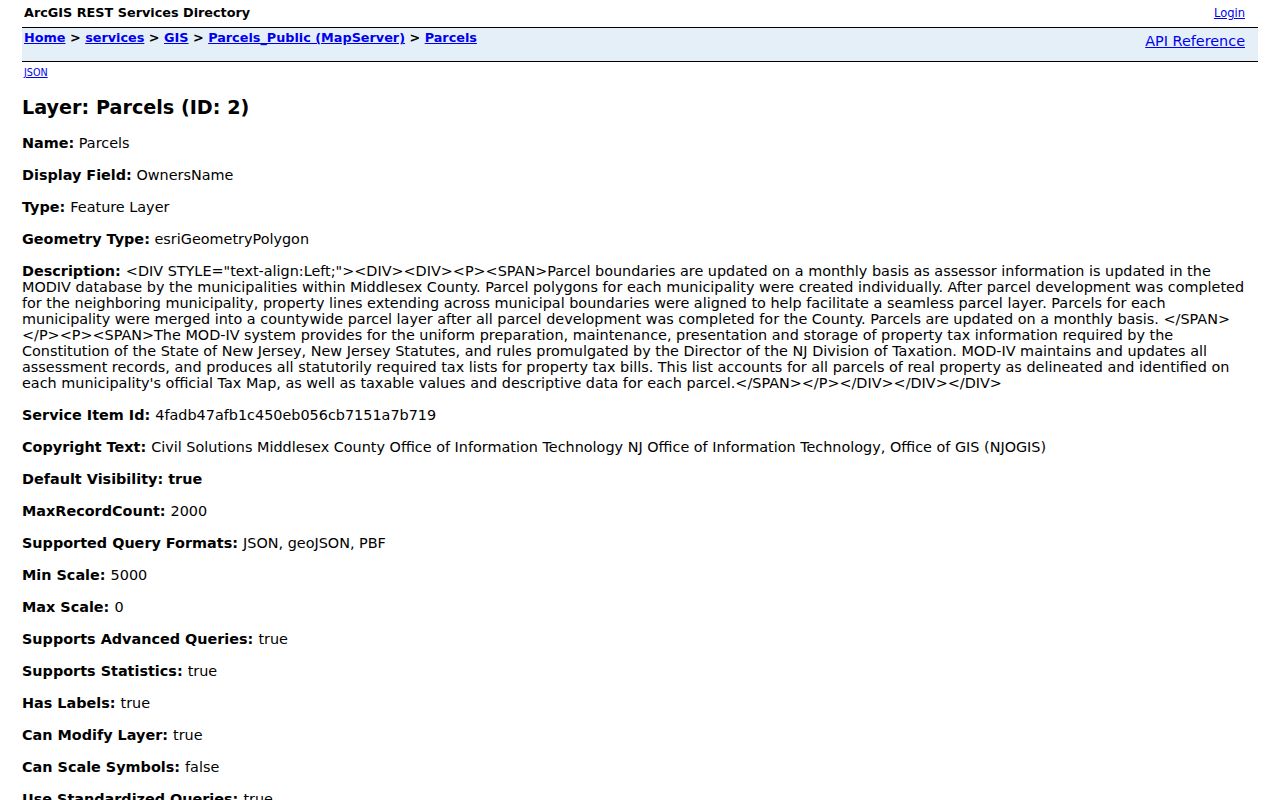
Those identifiers make a street directory search repeatable: save the parcel clue, then compare an address, an instrument, and a dated assessment record without assuming they all describe the same person.
Situs and Mailing Fields in Piscataway
Parcel records keep the physical location and the owner mailing contact in different fields. In the Middlesex layer, PropLoc is the situs, meaning the physical parcel location. OwnerAddr1, OwnerAddr2, and ZipCode describe owner mailing information. A Piscataway situs may have a mailing address elsewhere, and an owner name may be a trust, estate, business, or other recorded entity.
That distinction prevents a common address-research error. A mailing ZIP does not move the parcel outside Piscataway, and a parcel mailing line does not prove someone occupies the house. For a current municipal question, contact the Piscataway Tax Assessor at 455 Hoes Lane, 732-562-2328, and ask for the permitted way to inspect the specific assessment record.
- Parcel
- A defined piece of land represented by a tax and map identifier.
- Situs address
- The physical location of the parcel, shown here as PropLoc.
- Legal description
- The recorded land description used to distinguish property beyond a street number.
- Criss-cross directory
- An address-first directory format that can connect a street location to a dated household entry.
Trace Piscataway Deed Directions
Middlesex BrowserView should be searched in both directions. Start with the parcel identifier or a current assessment owner, then locate the newest recorded instrument. Record its document type, recording date, instrument number or book and page, and legal description. Search the named grantee to identify an acquisition, then run the prior grantor or seller as a name search to move backward. A quitclaim, mortgage, release, or easement can connect parties without showing a title change, so document type matters.
The county's stated online coverage is deeds from 1929 forward, mortgages from 1950 forward, and other documents from 1958 forward. A county digitization announcement says public deeds were brought online back to 1923, but the exact live cutoff varies by document type and should be confirmed with the County Clerk. BrowserView supports party name, instrument number, book and page, town, block and lot, document type, date range, legal-description, and parcel modes. Party names use Last-Name First-Name, without commas.
Use initials, punctuation changes, abbreviated names, entity forms, and separate grantor and grantee searches when the first query fails. BrowserView itself advises spelling variations. The public BrowserView portal shows the land-record search modes and its known controls.
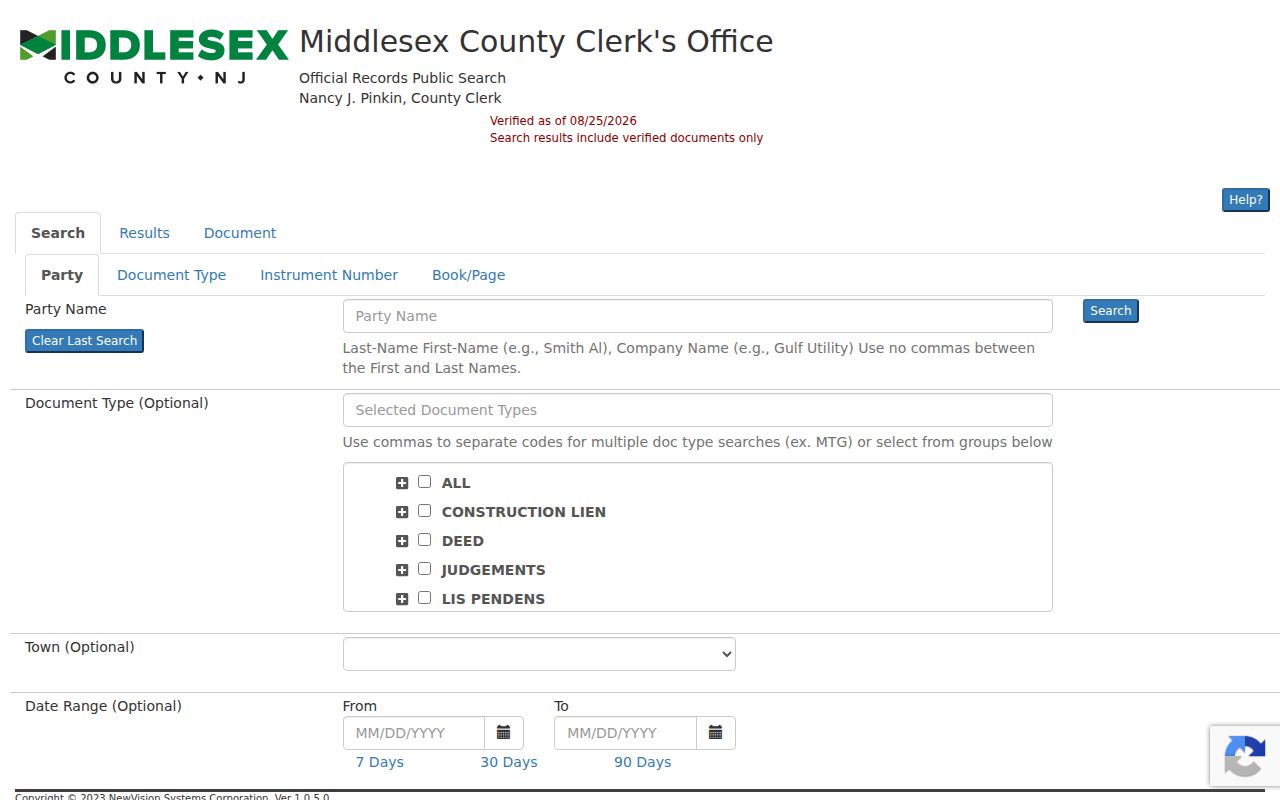
A recorded party belongs in a transaction history. Pair it with the parcel's legal description and a dated address source before drawing any conclusion about a household.
Piscataway Permit and Assessment Timing
Assessment data offers a different time stamp. The New Jersey property transparency route publishes annual January-collected property information, including owner and location, block and lot, assessed land and building values, prior-year tax, and property class. It is a useful dated comparison, not a live occupancy or payment feed. Changes after January can be absent from that annual snapshot.
Municipal permits can add address-specific project dates and applicant or owner evidence. Piscataway construction, engineering, sewer, zoning, tree, soil, pool, and street-opening processes point to local files that may exist. No dedicated public municipal permit-card search was located in the research. Call the assessor or Township Clerk, ask which card or record category is public, and submit a defined address, parcel, date-range request under OPRA when needed.
County and historical alternatives remain available if an online route does not answer the question. The Middlesex County Clerk at 75 Bayard Street maintains land records; the Board of Taxation handles assessment oversight; the State Archives holds older county deed microfilm and indexes; and the Piscataway Library local-history room can supply maps, house files, and manuscripts.
Note: Ask for a named record category and time range, because a narrow address request is more likely to reach the correct custodian.
Piscataway Street Directory Records
The Piscataway street directory becomes more useful when the record type stays visible. Parcel GIS connects a street location to tax-map attributes. Recorded instruments connect parties and legal descriptions. Assessment, permits, voter lists, and historical directories supply separate, time-bound evidence. The table keeps the access channels and limits distinct.
| Address record | Custodian | Address connection | Access path |
|---|---|---|---|
| Parcel GIS | Middlesex County GIS | Polygon, PropLoc, owner fields, block and lot, legal description. | Public county layer; monthly update context. |
| Recorded instruments | Middlesex County Clerk | Parties, town, instrument data, and legal-description references. | BrowserView, Clerk office, and defined request. |
| Assessment context | Piscataway Tax Assessor and state property data | Owner and location against an annual tax parcel. | Assessor contact, state data, or defined OPRA request. |
| Permit files | Piscataway municipal offices | Project address and possible applicant or owner context. | Confirm public fields with the office; use a defined request. |
| Voter list | Middlesex election offices | Registration address, party, ward, and district where authorized. | Statutory list route with protected fields omitted. |
| Historic directories | Library and archival collections | Dated street, surname, and rural-route clues. | New Brunswick-area runs, census, maps, and local history. |
The street name alone can repeat. The block, lot, legal description, and source date are the details that keep one Piscataway address from being confused with another.
Piscataway Voter Address Limits
New Jersey's voter-list statute, N.J.S.A. 19:31-39, permits specified public voter-list disclosures that can include name, address, party affiliation, ward, and district. It withholds signatures, Social Security numbers, driver-identification information, and protected covered-person addresses. Middlesex County can explain the current list-copy procedure and cost. The state voter registration page directs people to the official “Am I Registered?” route.
The live interactive field labels were not captured, so a DOB, last-four, CAPTCHA, or other unverified search field should not be assumed. The verified rule is that the name must match county data exactly. Hyphens, spaces, middle initials, nicknames, and prior or marriage-name differences can affect a match. A voter entry is one civic registration checkpoint, not a block roster.
Middlesex's Board of Elections is at 26 Kennedy Boulevard, Suite B, East Brunswick, and the County Clerk Elections Division uses the same East Brunswick location with a New Brunswick post-office box. Those offices are the practical contacts for a defined voter-list question.
Historic Piscataway Address Geography
Older address research has a local geography of its own. Middlesex County dates to 1683, while the Metlar-Bodine historical account dates Piscataway to 1666. Early records may use a broader place name, rural route, road, crossroad, or legal description rather than a modern street number. The New Jersey State Archives holds records from 1664 onward and can be a fallback for older county land, estate, court, naturalization, vital, and newspaper material.
The 1901-1908 New Brunswick-area directories explicitly include Piscataway, but later volume scope was not confirmed. Their rural-route wording is a reason to search the New Brunswick volumes even when a modern Piscataway address is the target. The River Road corridor also supplies stable landmarks: county historic material identifies sites at 1050, 1225, and 1281 River Road. Such landmarks orient a search; they do not prove who occupied an address.
For household history, collection detail belongs with the Piscataway directory book. Here, preserve original road or place wording, then compare it with a parcel's old block and lot and legal description before treating it as a modern address match.
Limits of a Piscataway Street Directory
A street directory can assemble public, address-keyed references, but it cannot turn them into a verified list of everyone inside a home. A deed records a transfer. A parcel field can name an owner or mailing contact. A voter record reflects registration when disclosure is authorized. A directory and census entry are historical snapshots. Each source has its own date, coverage, and protected-information rules.
When an online screen does not answer a narrow question, use the documented fallback chain: call the Piscataway Tax Assessor or Township Clerk, contact the Middlesex County Clerk for land records, visit or request material from the State Archives for older holdings, or use a defined OPRA request. Do not ask a custodian to assemble an unnamed person's entire file.
Lawful use. Use Piscataway address records for personal, lawful research and respect protected addresses and redactions. Never use an address search to stalk, harass, threaten, or harm another person.